No products in the cart.
A SLOWER ROAD TRIP THROUGH SWITZERLAND: 4 ALPINE VILLAGES
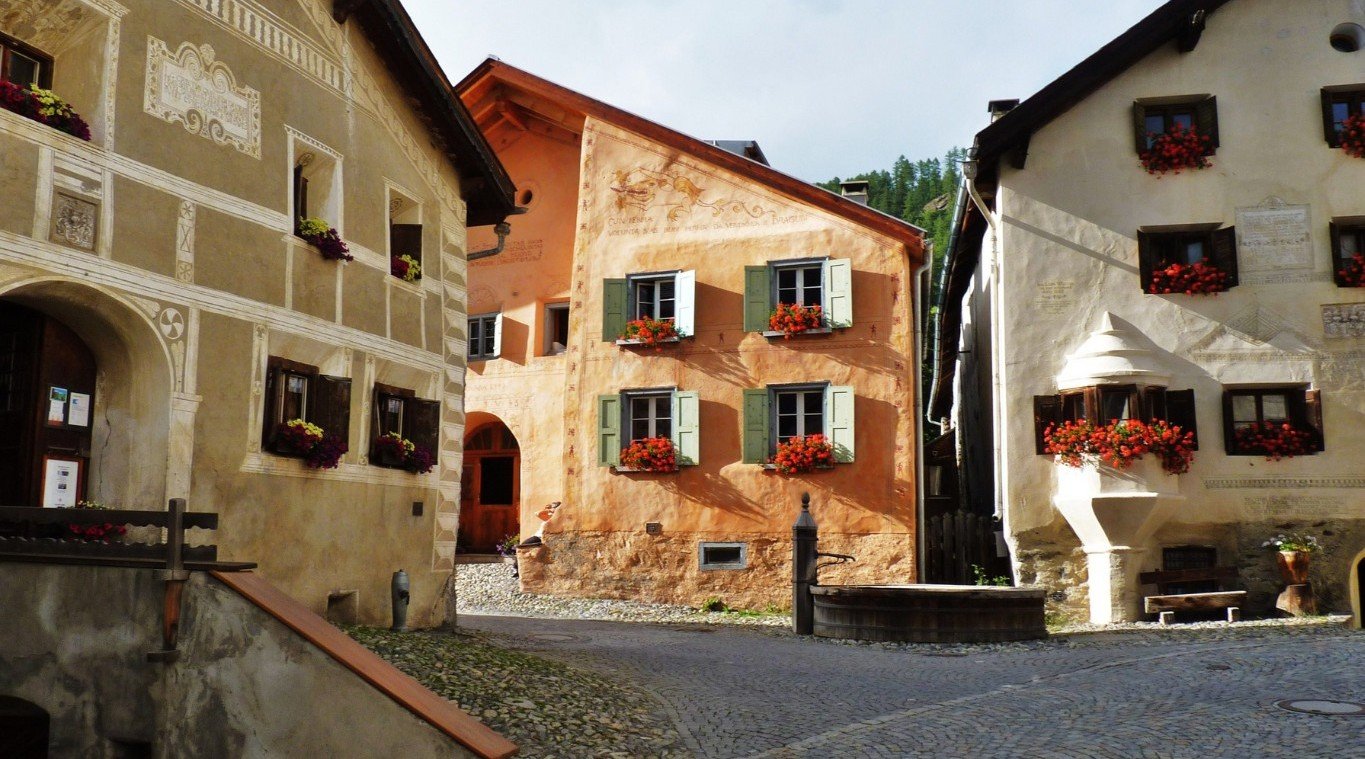
Photo above: Town square of Guarda © Erich Wucher
Explore Bosco Gurin, Juf, Guarda and Val Fex — and the long changes in landscape between them.
Some Swiss road trips are built around passes, viewpoints and the distance covered before nightfall. This one is better understood through arrival.
It begins in the Italian speaking canton of Ticino, where stone houses sit beneath chestnut forests, then climbs toward the exposed settlements of the Avers Valley. From there, the road enters the Engadin, passing villages shaped by sgraffito, Romansh culture and a stronger sense of altitude. The final stage leaves the car behind altogether.
Bosco Gurin, Juf, Guarda and Val Fex are not “undiscovered.” They are living places with their own routines, histories and limits. What connects them is not secrecy, but scale: each rewards travelers willing to remain longer than the photograph requires.
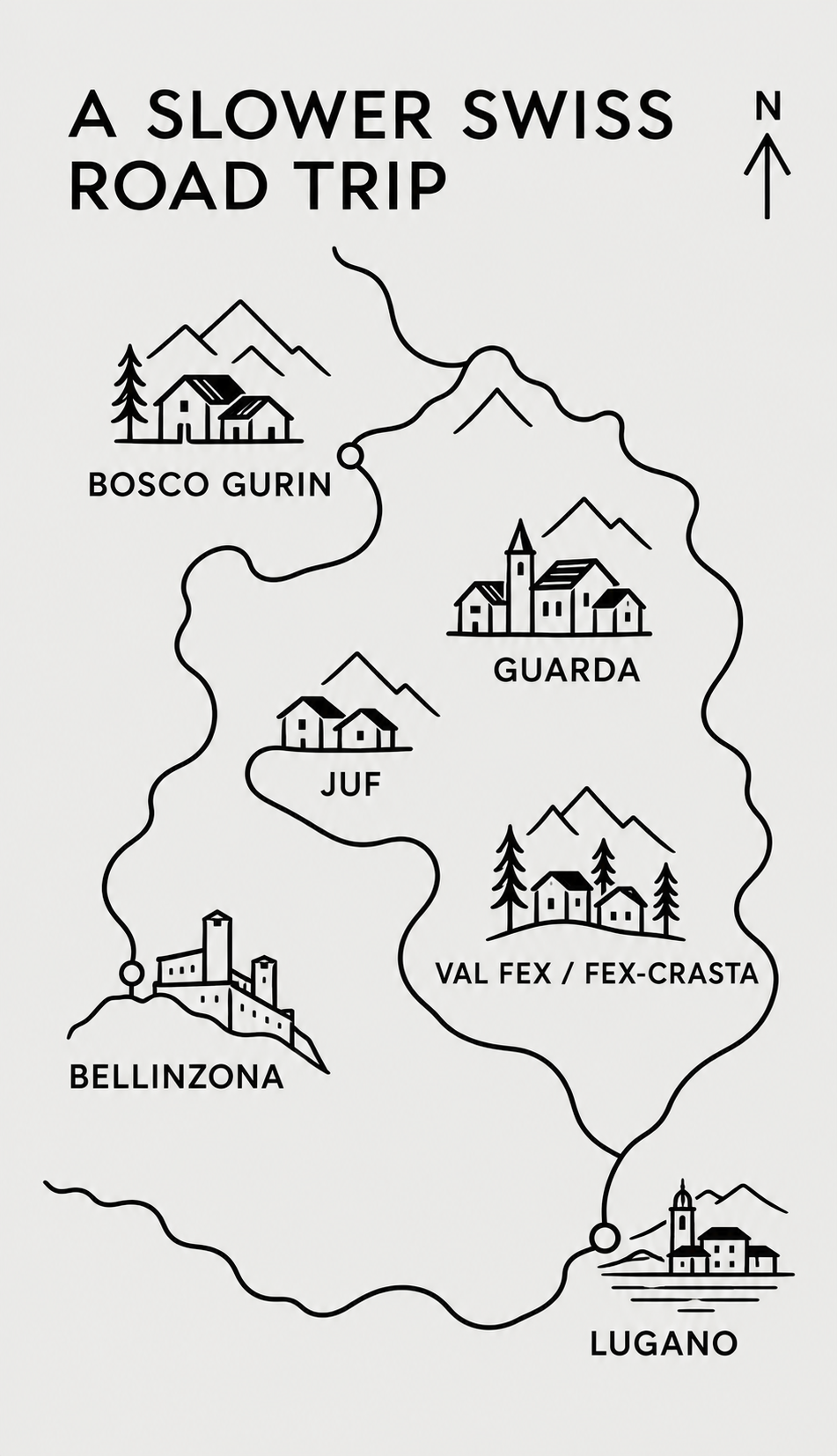
The Route at a Glance
Recommended time: 6–8 days
Best period: Late June to early October
Starting point: Bellinzona or Lugano
Final base: Sils Maria, with the option of returning south
Best suited to: Slow road travel, walking, village architecture and families comfortable with mountain roads.
This is not a route to compress into a long weekend. The transfer between Ticino and Graubünden takes time, and mountain weather can make a short distance feel considerably longer.
Allow two nights where possible. Check current road conditions, seasonal pass openings, museum hours and local transport before departure.

Photo of Bosco Gurin courtesy of ascona-ticino.ch
Bosco Gurin, Ticino
Walser history above the Maggia Valley
The road from Bellinzona to Bosco Gurin leaves the softer landscape of the lower valleys and climbs into a place with a noticeably different identity.
At around 1,500 meters, Bosco Gurin is the highest village in Ticino. Its stone foundations, dark timber houses and Walser heritage distinguish it from the Italian-speaking valleys below. German-speaking Walser settlers established the community centuries ago, and traces of that history remain in its architecture, language and local traditions.
The village is compact enough to explore slowly. Begin with the lanes surrounding the old houses, then visit the Walserhaus Museum, located inside one of Bosco Gurin’s historic dwellings. The interiors reveal more than a list of dates: they show how families organised domestic life, storage and work in an isolated mountain environment.
Beyond the village, walking paths move through meadow, forest and higher alpine terrain. Choose a route according to the weather rather than trying to complete a predetermined list.
Stay: Two nights
TN Note: The transition between stone and timber, the sound of water moving through the village and the changing light on the surrounding slopes.

Photo courtesy of Post Auto Avers-Juf Line
The Road from Ticino to Avers
The journey from Bosco Gurin to the Avers Valley is the longest transfer of the route. It should be treated as a travel day rather than an interruption between destinations.
The road descends from the upper Maggia Valley, crosses Ticino and then turns north toward the San Bernardino corridor and the interior valleys of Graubünden. Forest, exposed rock and settlement patterns change repeatedly along the way.
Stop when the landscape asks you to. The value of this section lies partly in experiencing how quickly Switzerland’s linguistic and geographical character can shift within a few hours.
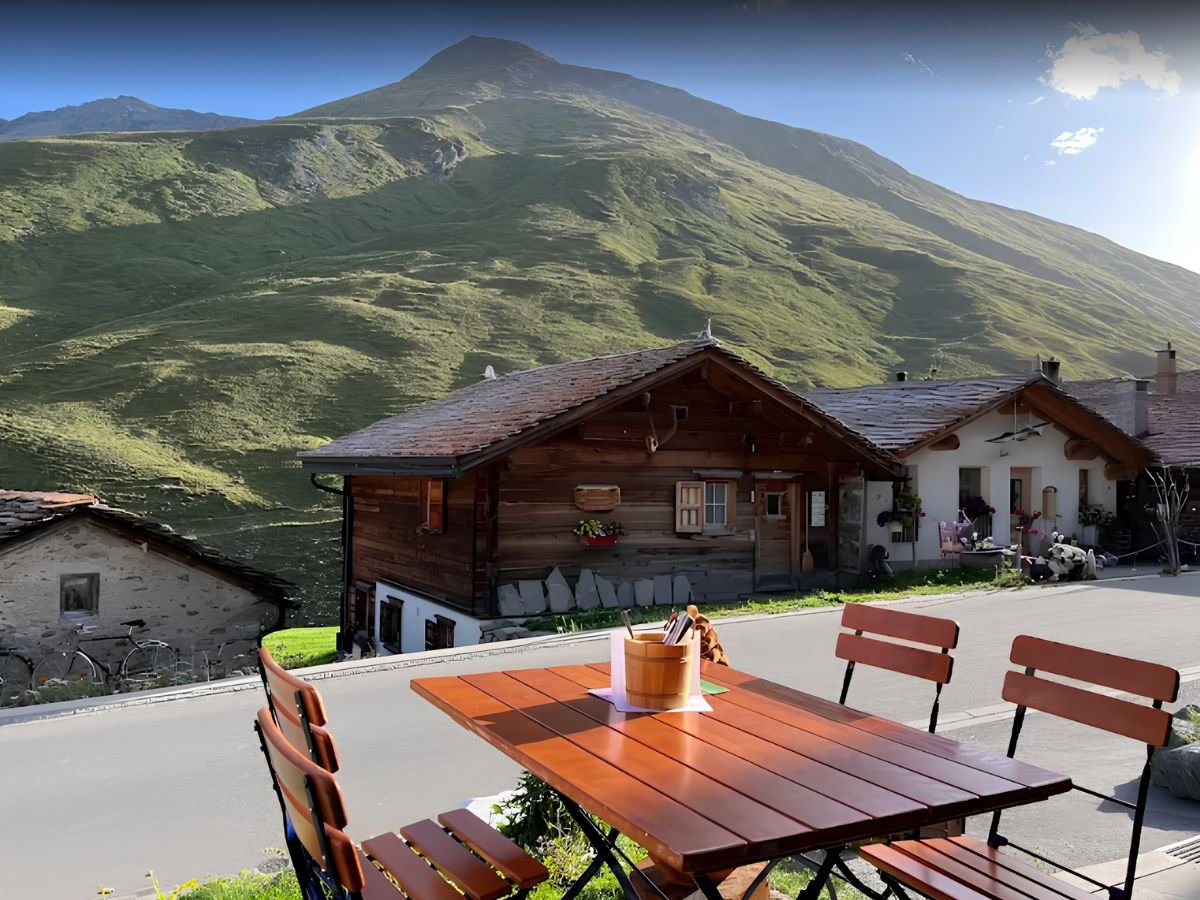
Driving through Avers Valley © Adrian Hügli
Juf, Graubünden
Life above the tree line
Juf sits at approximately 2,126 metres in the upper Avers Valley and is commonly described as Europe’s highest settlement inhabited throughout the year.
It does not feel like a conventional destination. There is no grand arrival square and little reason to rush from one attraction to another. Houses and agricultural buildings stand in an open, treeless landscape where weather remains visible from a distance.
The remoteness is carried in the air. Even in summer, the temperature can fall quickly when the sun disappears, and the surrounding slopes make human activity feel small.
Walk through the upper valley, follow part of the historic Avers road or choose a short path toward the quieter side valleys. The experience is less about reaching a summit than understanding the scale of a community that remains here through the winter.
Stay: One or two nights in the Avers Valley
Notice: The absence of trees, the movement of cloud shadows and how quickly sound disappears in the open terrain.

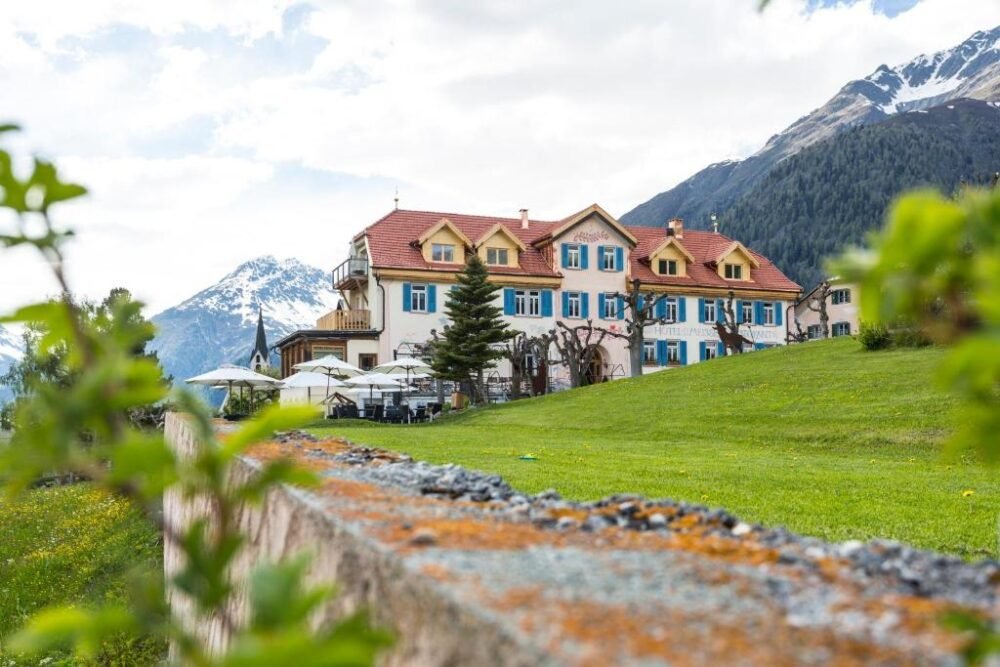
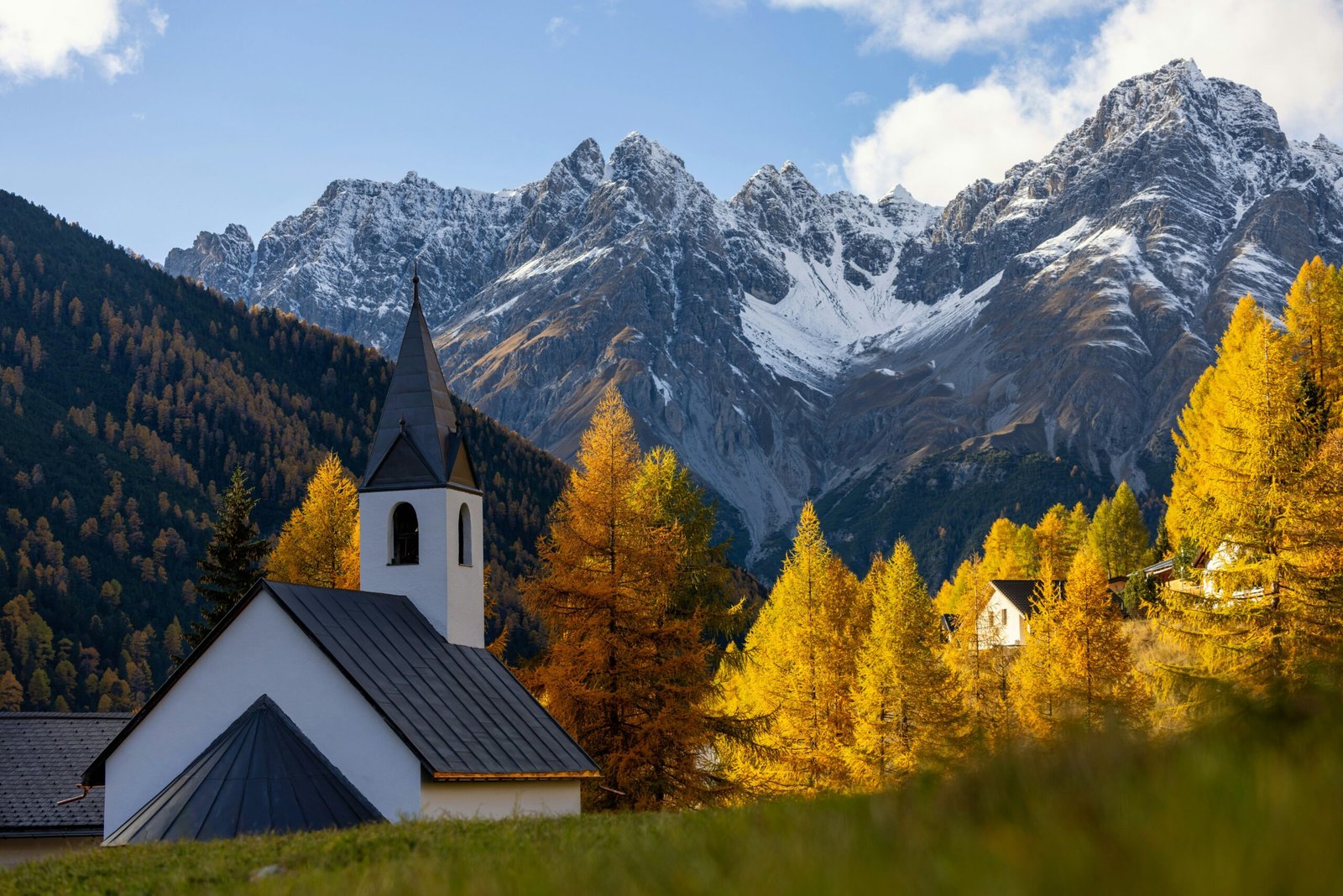
Photo courtesy of Hotel Meisser in Guarda.
Guarda, Lower Engadin
Sgraffito, fountains and village life above the Inn
Guarda occupies a sunny terrace above the Inn Valley. Its broad Engadin houses, deep-set windows and sgraffito facades create an architectural rhythm that is immediately recognizable but rewards closer observation.
Look beyond the decorated surfaces. Benches, fountains, stacked firewood and working entrances make clear that this is not an open-air museum. Guarda remains a lived-in village, even when its lanes appear almost impossibly composed.
The village is closely associated with Schellen-Ursli, the Swiss children’s story by Selina Chönz and Alois Carigiet. Families can follow the thematic trail above Guarda, while longer walkers can continue toward Ardez through meadows and forest paths overlooking the valley.
Allow time for the village itself: the façades change with the light, and details that disappear at midday become clearer toward evening.
Stay: Two nights
Notice: Sgraffito symbols, stone doorways, the sound of the fountains and the contrast between shaded lanes and the open valley below.

Val Fex and Fex-Crasta
Leaving the car behind
The final stage begins in Sils Maria.
Val Fex is closed to ordinary private traffic, so the road trip changes character here. Park in Sils and continue into the valley on foot or by horse-drawn carriage. In summer, a horse-drawn omnibus also operates on selected schedules; reservations and current times should be confirmed in advance.
The route passes Fex-Platta and Fex-Crasta before continuing deeper into the valley. Meadows rise toward larch forest and mountain walls, while small groups of buildings appear at intervals rather than forming one dense village center.
Fex-Crasta offers a natural place to pause. From here, continue walking farther into the valley or simply remain for lunch and return slowly to Sils. The point is not to cover every kilometre, but to experience the difference created by the absence of ordinary traffic.
Stay: One or two nights in Sils Maria
Notice: Hoofbeats on the road, the changing width of the valley and the way the landscape grows quieter beyond each settlement.
A Practical Seven-Day Rhythm
Days 1–2: Bosco Gurin
Arrive from Bellinzona or Lugano. Explore the village, visit the Walserhaus and take one weather-appropriate walk.
Day 3: Transfer to the Avers Valley
Treat the drive as part of the journey. Stop for lunch and allow more time than the navigation estimate suggests.
Day 4: Juf and the upper Avers Valley
Walk, observe the high-altitude landscape and avoid over-scheduling the day.
Days 5–6: Guarda and the Lower Engadin
Explore the village, follow part of the Schellen-Ursli trail or walk toward Ardez.
Day 7: Sils Maria and Val Fex
Leave the car in Sils. Enter the valley on foot or by carriage and finish the route at a different pace from the one in which it began.
Before Setting Out
Mountain roads and high-altitude conditions require flexibility.
- Check current road and pass conditions immediately before traveling.
- Do not rely exclusively on estimated driving times.
- Reserve accommodation in smaller villages in advance.
- Confirm museum and carriage schedules directly.
- Carry layers even in summer; temperatures change quickly above 2,000 metres.
- Keep the final day flexible if returning south across the Alps.
Four Villages, Rather Than Four Attractions
The value of this route is not that the villages are hidden. It is that they resist being experienced quickly.
Bosco Gurin reveals a Walser history inside Italian-speaking Ticino. Juf reduces the landscape to settlement, weather and open altitude. Guarda asks you to look closely at architecture that remains part of everyday life. Val Fex concludes the journey by removing the car.
Taken together, the four places offer a slower reading of Switzerland—one shaped not only by scenery, but by how people have learned and adapted to life within it.