

No products in the cart.
15 Historic Buildings in Switzerland — Stone, Landscape, and Everyday Life
Historic buildings in Switzerland are rarely separated from the landscapes around them.
Monasteries rise from mountain valleys. Arcaded old towns shape daily movement through cities. Railway hotels still sit beside alpine tracks first laid more than a century ago. Stone towers, wooden farmhouses, thermal bath towns, and lakeside castles remain woven into everyday life rather than preserved behind ropes and barriers.
Part of what makes historic architecture in Switzerland feel distinctive is this continuity. Many buildings are not treated as isolated monuments, but as living parts of villages, towns, train lines, and public space.
The experience of encountering them often becomes less about sightseeing and more about atmosphere: bells echoing through old streets, mountain weather moving over stone walls, trains arriving beside Belle Époque hotels, or evening light settling across arcades that have sheltered pedestrians for centuries.
Monasteries, Libraries & Places of Silence
1. Abbey of Saint Gall — St. Gallen
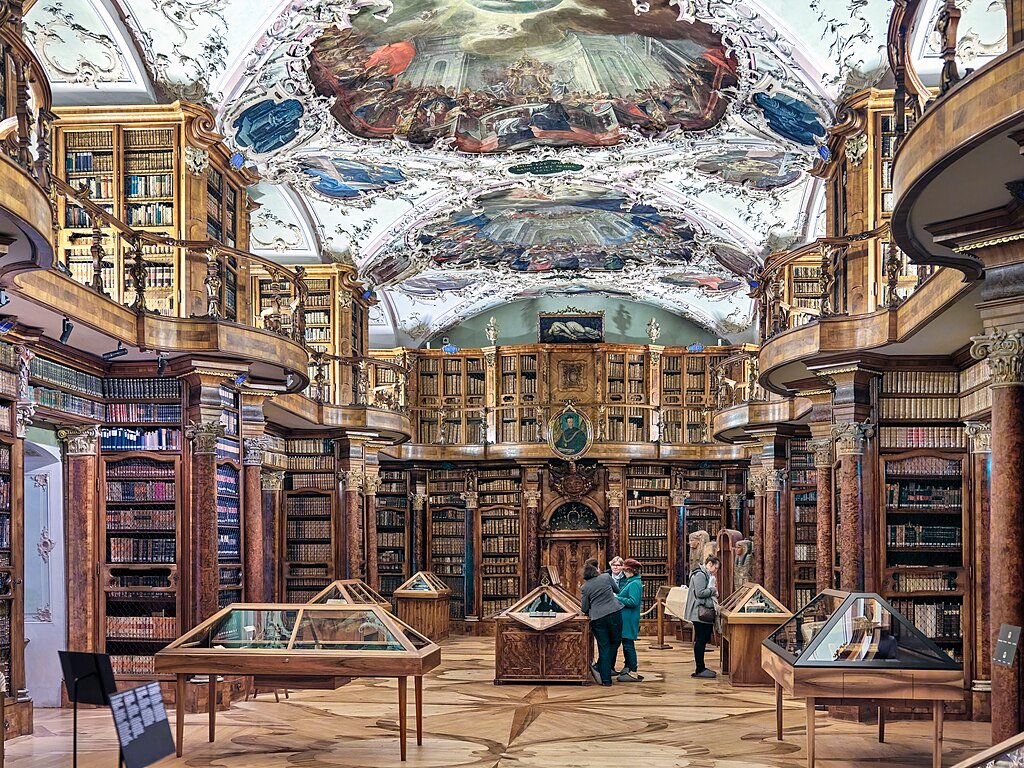
The Abbey of Saint Gall in St. Gallen remains one of the most important historic religious complexes in Switzerland, though what lingers most for many visitors is not scale, but atmosphere.
The library’s painted ceilings, old manuscripts, wooden floors, and quiet reading rooms create a feeling of continuity rarely found in modern public spaces. Even outside the abbey itself, the surrounding streets and arcades still feel shaped by centuries of scholarship, trade, and movement through eastern Switzerland.
Visit early or in quieter weather if possible. The building feels most compelling when the pace around it slows down.
2. Benedictine Convent of Saint John — Müstair
Near the Italian border in Müstair, the Benedictine Convent of Saint John sits within one of the quietest alpine valleys in the country.
Founded during the Carolingian era, the convent is known for its remarkable frescoes, but the setting matters just as much: mountain weather, long winters, stone walls, and a sense of isolation that still shapes the valley today.
Like much of Val Müstair, the experience feels less performative than deeply rooted in place and continuity.
3. Einsiedeln Abbey — Einsiedeln
The baroque abbey at Einsiedeln has long been a destination for pilgrims crossing central Switzerland.
What makes the complex interesting today is the way it still structures movement through the town itself. Pilgrims, visitors, students, and residents continue to pass through the square beneath the monastery towers much as they have for centuries.
In winter especially, the contrast between snow, dark roofs, bells, and warm interior spaces creates a distinctly Swiss atmosphere.
Railway Switzerland & the Belle Époque
4. Kurhaus Bergün — Bergün
Set beside the Albula Railway in Bergün, Kurhaus Bergün still carries the atmosphere of early alpine rail travel.
Long corridors, mountain light, old dining rooms, and the sound of trains moving through the valley connect the building closely to the rhythm of the surrounding landscape.
Unlike many restored grand hotels elsewhere in Europe, the beauty here feels understated rather than theatrical.
5. Victoria-Jungfrau Grand Hotel — Interlaken
Large Belle Époque hotels like the Victoria-Jungfrau in Interlaken reflect the period when rail travel transformed Switzerland into one of Europe’s great mountain destinations.
Yet even here, the surrounding landscape remains dominant. The building sits within a larger geography of lakes, valleys, trains, and mountain weather that still shapes the experience of arriving in the Bernese Oberland today.
6. Lucerne Railway Station — Lucerne
Railway stations are among the most quietly important historic buildings in Switzerland.
The station in Lucerne continues to function as both public infrastructure and gateway to central Switzerland: lake steamers, mountain railways, commuters, hikers, and travelers all moving through the same space.
Part of Swiss architectural continuity comes from this balance between historic structures and ongoing daily use.
Castles, Lakes & Defensive Landscapes
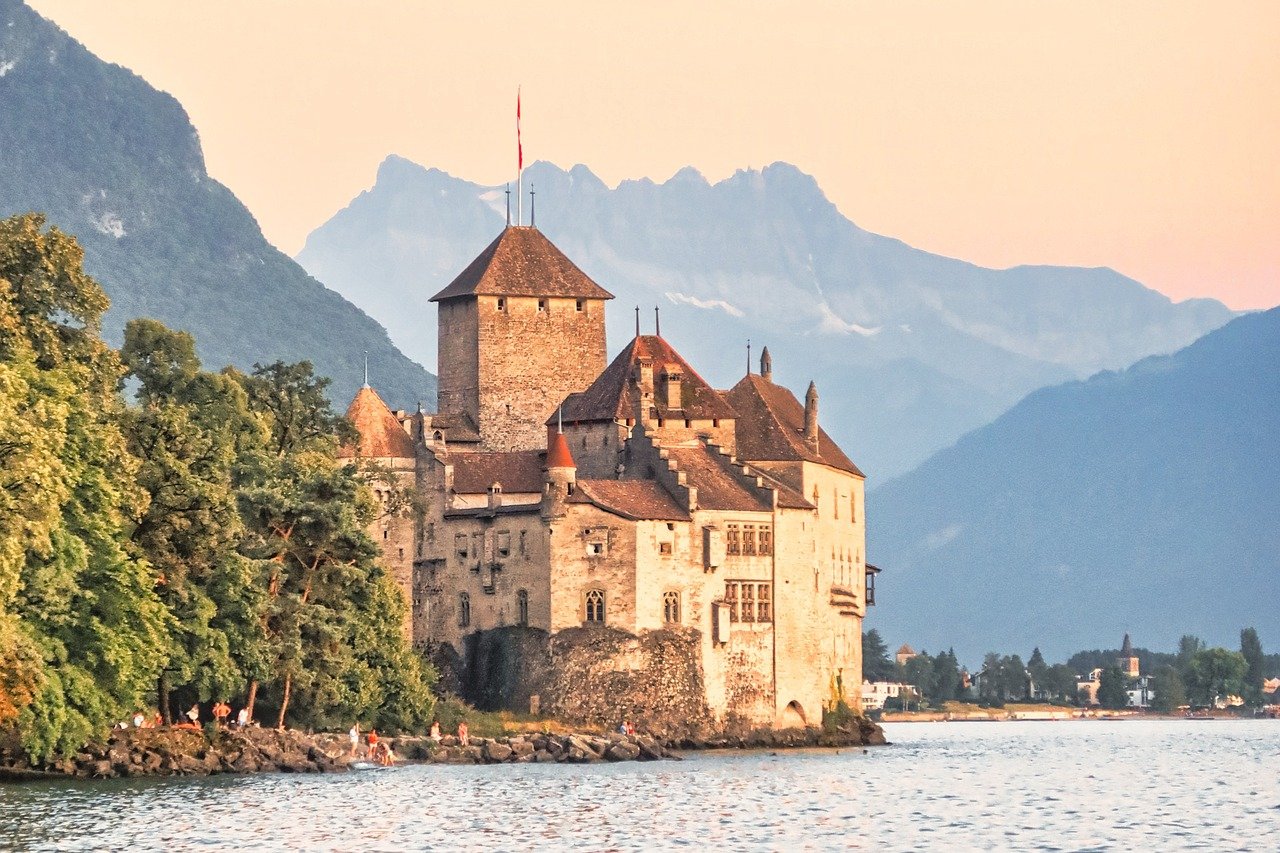
7. Chillon Castle — Lake Geneva
Set directly beside Lake Geneva, Chillon Castle feels less isolated from the landscape than anchored into it.
The stone structure rises directly from the water while weather moves visibly across the lake and mountains behind it. Visit in rain, fog, or quieter evening light if possible. The atmosphere becomes much stronger once the midday crowds thin out.
8. Castelgrande — Bellinzona
The castles of Bellinzona were built to control movement through key Alpine trade routes linking northern and southern Europe.
Today, Castelgrande still dominates the valley physically, but daily life continues around it: trains passing below, cafés opening in the old town, mountain weather shifting quickly through Ticino.
The architecture feels connected to geography rather than separated from it.
9. Schloss Thun — Thun
Overlooking the lake and river in Thun, Schloss Thun reflects the defensive architecture that once shaped movement through the Bernese Oberland.
What makes the town compelling today is not only the castle itself, but the relationship between river, bridges, arcades, cafés, and public space below it.
The historic architecture still participates naturally in everyday movement through the town.
Villages Built for Climate & Continuity
10. Soglio — Bregaglia Valley
In Soglio, stone houses and narrow streets appear almost inseparable from the mountain landscape around them.
The village’s historic buildings feel shaped less by ornament than by weather, altitude, and centuries of alpine life. Light changes quickly here, especially in autumn and winter, when the stone surfaces begin to absorb the atmosphere of the valley itself.
11. Vrin — Graubünden
The architecture of Vrin reveals another side of Swiss building culture: continuity through adaptation.
Traditional alpine structures sit beside newer buildings designed carefully around local materials, climate, and village scale. Rather than freezing the village in time, the architecture demonstrates how older building traditions can continue evolving without losing connection to place.
12. Guarda — Lower Engadin
The Engadin village of Guarda is known for its decorated façades and thick stone houses built for long alpine winters.
Yet the atmosphere remains surprisingly calm and lived-in. Wooden doors, fountains, narrow lanes, and mountain silence still shape the rhythm of daily life here more than tourism itself.
Arcades, Public Space & Everyday Switzerland
13. Old Town Arcades — Bern
The arcades of Bern remain among the clearest examples of historic architecture still fully integrated into contemporary public life.
Markets, bakeries, bookshops, cafés, apartments, and everyday pedestrian movement continue beneath the covered walkways much as they have for centuries.
Visit during rain if possible. The architecture becomes especially atmospheric once the stone streets darken and the arcades begin to shelter the city from weather again.
14. Rathaus — Basel
The bright red Rathaus in Basel still anchors the political and civic life of the city centuries after its construction.
Yet what makes the surrounding architecture memorable is less monumentality than rhythm: trams crossing the square, market stalls opening in the morning, people moving between the Rhine, old town streets, and public spaces throughout the day.
Historic architecture in Switzerland often remains deeply tied to ordinary urban movement.
15. Münsterplatz & Cathedral Quarter — Lausanne
The cathedral district in Lausanne rises steeply above Lake Geneva, connected by stairways, terraces, and narrow streets shaped by the city’s dramatic topography.
The experience of moving through the quarter reveals how closely Swiss architecture often responds to geography itself. The buildings follow slope, weather, and movement rather than imposing symmetry against the landscape.
Why Swiss Historic Buildings Feel Different
Historic architecture in Switzerland often feels quieter than in parts of France, Italy, Austria, or Germany, where cities may be shaped by grand boulevards, imperial squares, ornate churches, or highly decorative façades.
Switzerland has those moments too, but much of its historic architecture feels more practical and landscape-bound. Stone walls, wooden barns, steep roofs, shutters, fountains, arcades, and narrow streets were shaped by weather, altitude, farming life, trade routes, and winter conditions.
The result is architecture that often feels lived-in rather than staged. These buildings are beautiful, but their beauty comes from use, care, and continuity — not from trying to impress.
Tour Noir Note
Historic buildings in Switzerland rarely stand apart from daily life. Trains still arrive beside old hotels, arcades still shape movement through cities, monastery bells still echo through mountain valleys.
Part of their power comes from continuity: the feeling that these places were not preserved only to be looked at, but remain woven into the rhythm of the landscape itself.
Continue Exploring Switzerland with TOUR NOIR
If you are drawn to quiet, local, and slightly unexpected sides of Switzerland, you may also enjoy:
- Equestrian Dreams in Switzerland — countryside riding, alpine routes, and rural atmosphere.
- 15 Historic Buildings in Switzerland — architecture shaped by stone, landscape, and everyday life.
- 20 Things to Know Before Traveling to Switzerland — cultural notes for a more thoughtful trip.
- Thermal Bath Culture in Switzerland — water, weather, and winter ritual.
- En FRANÇAIS? – A Language Guide for French-Speaking Switzerland

TOUR NOIR is a guide to Switzerland beyond the obvious: slower, quieter, and more atmospheric.


Leave a Reply