

No products in the cart.
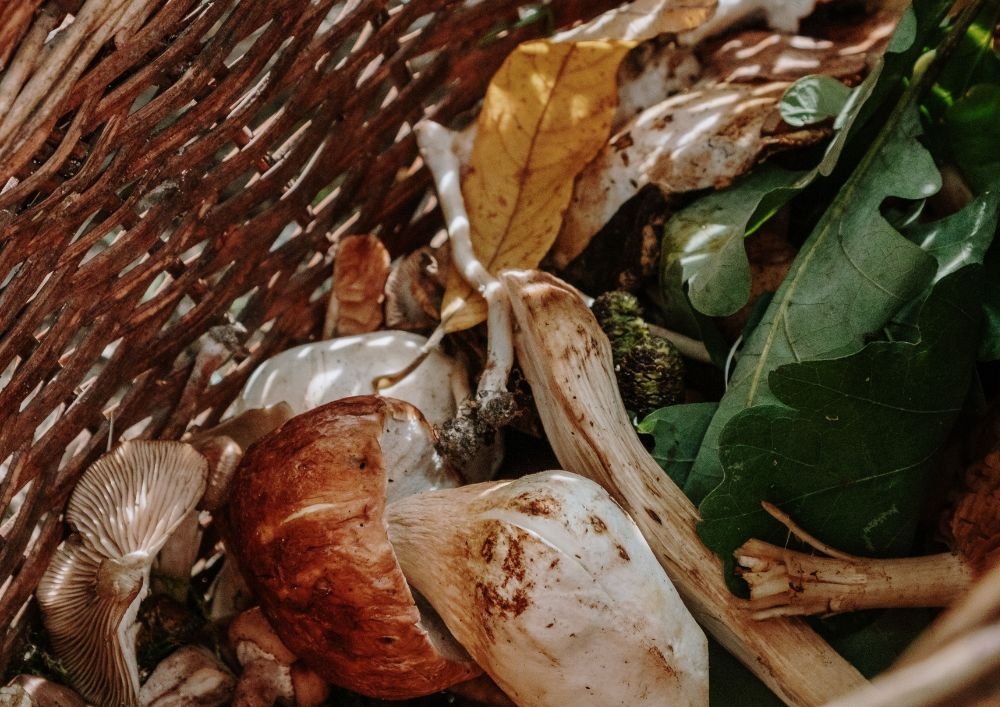
Mushroom Foraging in Switzerland: Forest Walks, Local Knowledge, and the Quiet Rituals of Autumn
Forest Walks, Local Knowledge, and the Quiet Rituals of Autumn
There is a point in the Swiss autumn when attention begins to move downward.
Forest paths darken after rain. Moss thickens around roots and fallen branches. Beneath beech, spruce, and fir, mushrooms appear briefly and unpredictably — often almost invisible until someone shows you how to look.
Mushroom foraging offers a quieter way into the Swiss landscape. It is part woodland walk, part food culture, and part inherited knowledge. It also requires restraint. Knowing what may be gathered is only one part of the practice; knowing what should be left untouched matters just as much.
Across Switzerland, guided walks introduce beginners to this seasonal world. Some take place in alpine forests above the Rhône Valley. Others begin within easy reach of Basel or Zurich. A few continue from the woodland into the kitchen, connecting identification with preparation and a shared meal.
The reward is not necessarily a full basket. It is a more attentive relationship with the forest.
The Swiss Mushroom Season
Mushroom season does not follow an exact calendar. Rainfall, temperature, elevation, soil, and forest type all influence what appears and when.
Late summer and autumn are the main seasons for guided outings, but conditions vary from year to year. A knowledgeable guide is not simply leading participants towards a guaranteed harvest. They are teaching them how to read the landscape: the nearby trees, the moisture in the soil, and the often-invisible systems beneath the forest floor.
The best excursions place observation before collection.
Veysonnaz, Valais
A Slow Forest Experience Above the Rhône Valley
In the forests above Veysonnaz, trails pass through moss, meadow edges, and shaded woodland, where mushrooms appear briefly with the season and disappear just as quickly.
The Veysonnaz Mushroom Workshop offers a guided introduction to this hidden side of Valais: part nature walk, part local knowledge, part slow mountain experience. Participants learn how to observe the forest floor, recognise different kinds of mushrooms, and understand why respectful harvesting matters.
The workshop lasts approximately three hours and begins at the Veysonnaz Tourist Office. It is open to adults and children from the age of ten, making it a thoughtful option for families with older children who enjoy walking and learning outdoors.
The experience is less about gathering as much as possible than learning what may be collected, what should be left alone, and how local knowledge is shaped by patience and repetition.
Some places in the forest are shared. Others are remembered quietly by those who return year after year. That, too, is part of the culture.
Practical Details
Meeting point: Veysonnaz Tourist Office
Duration: Approximately three hours
Suitable for: Adults and children aged ten and over
Season: Selected dates from late summer into autumn
Advance booking: Required
Bring sturdy shoes, weather-appropriate layers, water, and a basket or breathable bag if requested. Confirm current dates, prices, and start times directly with Veysonnaz Tourisme.
Basel and the Fricktal
Mushroom Country Beyond the City
Beyond Basel, the wooded hills of Basel-Landschaft, the Jura foothills, and the forests of the Fricktal provide a rural counterpoint to the city.
The region works particularly well for visitors who want to combine Basel’s museums and architecture with a quieter autumn experience.
Pilzerlebnis offers excursions and courses in the Fricktal, Aargau, Basel, and Basel-Landschaft. Programmes are available for beginners, families, and participants with some previous knowledge.
The outings are not limited to edible varieties. Participants may encounter fungi growing on wood, unusual seasonal species, and mushrooms whose ecological significance has little to do with the kitchen.
Courses cover identification, the relationship between fungi and trees, responsible gathering, and the preparation of edible finds. Private excursions may also be arranged for families and groups.
Walking with a local guide reveals how much remains unnoticed during an ordinary forest visit. Mushrooms are not isolated objects. They belong to a wider system of soil, roots, moisture, insects, and decaying organic matter.
For TOUR NOIR, Basel and the Fricktal also offer a conversation with a local guide could explore how the season changes, which mistakes beginners make, and why productive collecting places are often kept private.
That discretion is not merely secrecy. It reflects experience, repetition, and respect for the landscape.
Zurich and the Sihlwald
A Forest Experience Within Reach of the City
South of Zurich, the Sihlwald offers another setting for mushroom exploration.
Although it lies within easy reach of the city, its shaded paths, fallen wood, and dense undergrowth feel far removed from an urban itinerary.
Guided excursions introduce participants to the principles of mushroom collecting and identification. English-language walks are especially useful for international visitors who may not have the German vocabulary required for a technical nature course.
A typical outing lasts around three hours. Participants examine features such as caps, stems, pores, gills, texture, habitat, and scent.
The aim is not to memorise an entire field guide in one afternoon. It is to begin recognising the details that separate one species from another — and to understand how much caution that process requires.
The Sihlwald fits easily into a longer Zurich stay, offering a seasonal counterpoint to the city’s galleries, lakefront, and familiar landmarks.
Entlebuch
From Forest Floor to Shared Table
In the Entlebuch, mushroom culture often becomes a fuller culinary experience.
Set among wooded slopes, farms, moorland, and pre-Alpine valleys, guided courses may combine a forest walk with identification, kitchen preparation, and a shared meal.
This creates a natural progression: observing mushrooms in their habitat, then learning how carefully identified edible varieties can be cleaned, handled, preserved, and cooked.
The appeal is not simply eating something gathered in the forest. It is the connection between landscape and table.
A culinary course also shows that mushroom foraging does not end when the walk is over. Every specimen must be checked, sorted, cleaned, and prepared correctly.
The Entlebuch format suits travelers who enjoy participatory food experiences but want something more grounded than a conventional tasting. Confirm the language, duration, physical demands, and exact inclusions before booking.
Learning to Look, Not Simply to Collect
Mushroom foraging is often described in terms of the search: finding chanterelles, locating porcini, or returning home with enough for dinner.
A good guided walk shifts that emphasis.
Participants begin to notice fungi with no culinary value but an essential role in the forest. They learn how fungi break down organic matter, form relationships with trees, and support processes taking place largely out of sight.
There is also an etiquette to gathering.
Take only what you can identify, inspect, and use. Avoid very young or overly mature specimens. Do not disturb mushrooms simply because they are inedible. Observe local limits, protected areas, and seasonal restrictions.
A full basket is not the only measure of a successful outing. Sometimes the most memorable discovery remains where it was found.
Mushroom Inspection in Switzerland
One of the most distinctive aspects of Swiss mushroom culture is its network of official inspection services.
Inspectors examine gathered mushrooms and help determine which are edible, inedible, spoiled, or poisonous. Their role is essential because similar-looking species can be difficult to distinguish.
Anyone gathering wild mushrooms for consumption should locate the nearest official control point before entering the forest. Opening periods vary by municipality and season.
Bring the complete collection for inspection, keep different species separate, and avoid cutting away characteristics the inspector may need to see.
A photograph, mobile app, field guide, or online forum should never replace an in-person assessment by a qualified specialist.
TOUR NOIR does not provide mushroom-identification advice. No wild mushroom should be eaten unless its identity and condition have been confirmed by an appropriately qualified expert.
Before You Gather
Join an expert-led walk.
For beginners, a guided excursion is the safest and most meaningful introduction.
Check local regulations.
Rules differ between cantons, municipalities, forests, and protected areas.
Use a basket or breathable bag.
Avoid sealed plastic bags, which can cause mushrooms to deteriorate.
Collect complete specimens.
An inspector may need to see the cap, stem, base, and other identifying features.
Keep species separate.
This makes inspection easier and prevents fragments from becoming mixed.
Do not rely on photographs or apps.
Images rarely show everything needed for safe identification.
Gather with restraint.
Take only what you can use.
When in doubt, leave it untouched.
What to Bring
A typical excursion requires little specialist equipment.
Bring sturdy walking shoes, long trousers, layered clothing, a waterproof jacket, water, and a small notebook. A basket or breathable bag may be useful if requested by the organiser.
Check whether the guide provides baskets, knives, or identification materials before purchasing anything specifically for the outing.
Mushroom Walks with Children
A well-structured mushroom walk can be especially engaging for older children.
The forest becomes a place of clues: colour, shape, smell, texture, tree type, and location all matter. Children who enjoy mysteries or nature observation often respond naturally to the experience.
They must understand, however, that no mushroom should be tasted or handled carelessly. Age limits vary, and some technical courses are intended for adults.
The best family excursions balance explanation with movement and discovery.
Planning an Autumn Mushroom Weekend
Mushroom excursions fit naturally into a slower two- or three-day journey.
In Veysonnaz, combine the workshop with a walk along one of the historic bisses and a stay overlooking the Rhône Valley.
Around Basel and the Fricktal, pair a forest excursion with a day in the city, a Rhine walk, or an overnight stay in Rheinfelden.
Near Zurich, use the Sihlwald as a counterpoint to museums and lakefront walks.
In the Entlebuch, allow the landscape to set the pace. A food-focused course fits naturally alongside village stays, farm products, and woodland walks.
Avoid building a rigid itinerary around finding a particular species. Conditions are unpredictable. The guided walk should be the experience; anything gathered is secondary.
A Different Way of Entering the Forest
Mushroom foraging changes the scale of a journey.
The dramatic elements of Switzerland — peaks, passes, lakes, and glaciers — temporarily recede. Attention settles instead on a patch of moss, the underside of a cap, the smell of damp soil, or the relationship between a tree and what is growing beneath it.
The forest does not perform on demand. Nothing is guaranteed to appear simply because a workshop has been booked.
Perhaps that is precisely what makes the practice meaningful.
You walk slowly. You learn to distinguish looking from noticing. For a few hours, the smallest details become the landscape.
Workshop dates, prices, languages, and meeting points may change. Always confirm current information directly with the organiser and check the collecting regulations for the relevant canton or municipality.
Continue Exploring Switzerland with TOUR NOIR
If you are drawn to quiet, local, and slightly unexpected sides of Switzerland, you may also enjoy:
Equestrian Dreams in Switzerland — countryside riding, alpine routes, and rural atmosphere.
15 Historic Buildings in Switzerland — architecture shaped by stone, landscape, and everyday life.
20 Things to Know Before Traveling to Switzerland — cultural notes for a more thoughtful trip.
Thermal Bath Culture in Switzerland — water, weather, and winter ritual.
En FRANÇAIS? – A Language Guide for French-Speaking Switzerland 
TOUR NOIR is a guide to Switzerland beyond the obvious: slower, quieter, and more atmospheric.

"Ucretsiz hesap olusturun
–Your article helped me a lot, is there any more related content? Thanks!